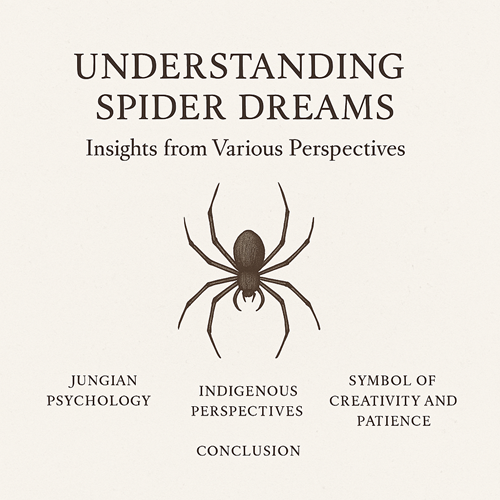
Dreams about spiders can leave a strong emotional residue. Some people wake in fear, others in fascination, and some with a quiet sense that the dream was important. This range of responses is essential to interpretation.
Want to understand what your dream is telling you? Get a personal AI analysis tailored to your context, and what's going on in your life — in 2 minutes.
Get free analysisSpider imagery often carries tension: creator and trapper, patience and paralysis, precision and control. Because of that, one fixed meaning is rarely useful. A better approach is to read the dream through context, felt sense, and symbolic depth.
A Clear Starting Point
Before interpreting, begin with three questions. What did you feel in the dream? What exactly happened with the spider? What in your current life feels emotionally similar?
This simple check prevents symbolic overreach. A spider dream after a real spider scare may reflect immediate stress. The same dream during a life transition may point to deeper pattern change.
Jungian Lens: Shadow and Pattern-Making
In a Jungian frame, spiders can point to shadow content, parts of the psyche that are active but not yet integrated into conscious identity. The spider can also symbolize the psyche as a pattern-maker, weaving structures of relationship, identity, and meaning.
In some dreams, the spider image appears when control dynamics are tightening. In others, it appears as a sign of intelligence, strategic patience, and creative design. The key is not choosing one meaning in advance, but examining the emotional tone and life context around the image.
A useful Jungian prompt is this: what pattern in my life is being woven without my full awareness?
Processwork Lens: The Spider as an Emerging Role
From a Processwork perspective, the spider is a dream role that may represent an emerging quality at your edge. That quality might be stillness, precision, boundary intelligence, timing, subtle power, or in some cases, indirect control.
A short Processwork sequence can make the dream practical:
- Name your primary identity in waking life right now.
- Describe what the spider does in the dream, not what it means.
- Identify which spider quality feels least like you.
- Practice one micro-action in daily life that expresses that quality consciously.
This turns the dream from interpretation alone into integration.
Indigenous-Informed Lens: Creation and Relationship
Across some Indigenous traditions, spider figures are associated with creation, teaching, and interconnection. In this relational view, the dream may ask how you are weaving your life through commitments, speech, craft, and responsibility to others.
A careful reading here avoids universal claims. Meanings differ across peoples and lineages. The most respectful way to work with this lens is to treat it as guidance about relationship and integrity, not as a single code that applies everywhere.
Common Spider Dream Patterns
When the spider builds a web, the dream often emphasizes craft, long-range process, and patient construction. When many small spiders appear, it can reflect accumulated minor stressors or diffuse anxiety. One very large spider may point to a dominant issue that can no longer be ignored.
A bite may signal a sharp emotional impact, a boundary breach, or a truth that breaks through quickly. Being chased by a spider often suggests avoidance of a quality or conflict that keeps returning. Killing a spider may represent regained agency, but it can also mean rejecting a needed capacity such as patience or strategic attention. A spider in your bed, home, or on the body usually intensifies themes of intimacy, safety, and personal boundaries.
Example
Sarah, 32, dreamed of a large spider weaving across the doorway of her studio. She felt both uneasy and mesmerized. In waking life, she was creatively blocked, rushing deadlines, and becoming increasingly controlling with collaborators.
Through a three-lens reading, the dream became clear. Jungianly, it reflected a pattern conflict between control and organic creation. In Processwork terms, it introduced an emerging quality of strategic patience. Through a relational lens, it pointed to the need for cleaner agreements and less urgency in collaboration.
She responded with one protected slow-design hour each day, clearer project boundaries, and scheduled feedback windows instead of reactive edits. Within weeks, her anxiety dropped and creative flow returned.
Interpretation Tensions
Spider dreams often hold opposites at once. They can point to creation and entrapment, patience and paralysis, sensitivity and control. This is normal. Precision comes from tracking feeling, pattern, and life context over time.
When to Seek Extra Support
If spider dreams are frequent, panic-provoking, phobia-linked, or significantly disrupting sleep, additional support can help. Dream-focused therapy or trauma-informed work can reduce fear and support integration.
Final Thoughts
Spider dreams invite you to examine how you are weaving your life right now. They can reveal where more patience is needed, where boundaries need refinement, and where unconscious patterns are shaping outcomes. Read with care, test meanings through action, and let the dream become a tool for conscious pattern-making.