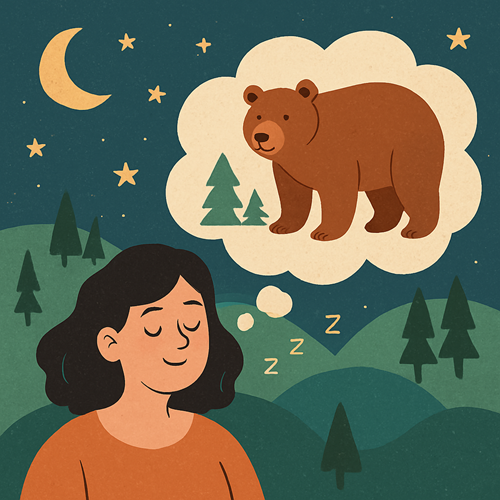
Dreams are stories our psyche tells us when the conscious mind finally goes quiet. Among the creatures that visit us in this liminal space, the bear is one of the most powerful and mysterious. If you've recently had a dream about a bear, you might be wondering what it means. Is it a sign of strength, a warning, or something deeper within?
Want to understand what your dream is telling you? Get a personal AI analysis tailored to your context, and what's going on in your life — in 2 minutes.
Get free analysisThis article is here to help you unfold the symbolic and emotional meaning behind bear dreams, offering perspectives from ancient traditions, Processwork psychology, and everyday experience. If you’re curious how dreams offer guidance in general, you might also enjoy our article on what dreams are trying to tell. Let's walk gently into the forest of dream interpretation together.
How to read this article: we use three complementary lenses. First, Processwork (the dream as an emerging process at your edge). Second, Jungian psychology (the archetypal and instinctual meaning of animal imagery). Third, selected Indigenous teachings from specific traditions. These lenses are not identical; they are meant to be held in dialogue, not merged into one “universal” meaning.
Ancestral Wisdom: The Bear in Indigenous Traditions
Across many Indigenous cultures, the bear is a revered figure. In Native American traditions, bears are often seen as protectors, healers, and symbols of courage. The bear’s ability to hibernate is viewed as a powerful metaphor for introspection, transformation, and emerging anew.
In the Haida culture, the bear is a maternal figure - strong, nurturing, and fiercely protective. Similarly, in Siberian shamanism, dreaming of a bear may indicate a calling to connect with one’s inner power or spiritual guidance. These cultures encourage us to look at the bear not just as a fearsome animal, but as a wise elder and a symbol of connection to the land and one's self.
Editorial note on respect and accuracy: Indigenous nations and lineages are diverse, and meanings are not interchangeable. It is more accurate to say “in some traditions” rather than assign one fixed Indigenous meaning to the bear.
The Processwork View: A Symbol of Power, Edges, and Transformation
From a Processwork perspective, dreams are more than just nightly brain noise - they're meaningful expressions of parts of ourselves that are trying to emerge. The bear often represents a powerful force, something beyond our usual identity. It can symbolize raw emotional energy, inner authority, or even repressed anger or protection.
If you dream of a bear, ask: where in your waking life are you being too gentle when you need to be strong? Are you suppressing a part of you that wants to roar? Or maybe you're being confronted by a bear-like force - something big, looming, and possibly threatening - that's inviting you to grow beyond your current edge.
Processwork mini-protocol (use after any bear dream):
- Primary identity: Who am I being in daily life right now? (e.g., agreeable, careful, conflict-avoidant.)
- Secondary process: Which bear-quality appears “not me”? (territoriality, stillness, force, protection, instinct, solitude.)
- Edge: Where do I feel discomfort, embarrassment, or “I can’t be like that”?
- Signal amplification: Gently amplify one signal from the dream (posture, breath, sound, pace, gaze) for 30-60 seconds and notice what emerges.
- Micro-integration: Choose one small waking action today that honors the emerging quality (one boundary sentence, one direct ask, one protected hour, one clear no).
A Jungian Companion Lens: Instinct, Shadow, and the Self
In Jungian terms, animal dreams often carry instinctual intelligence that the conscious personality has underused or repressed. A bear may appear when your psyche is compensating an overly adapted daytime stance.
Three useful Jungian patterns:
- Bear as instinctual life-force: the body’s truth, appetite, anger, and protection seeking expression.
- Bear as shadowed authority: a strong part you may project outward (“the threatening boss”) instead of owning inwardly.
- Bear as numinous presence: in some calm encounter dreams, the bear can function as a Self-like image - grounded power that does not need to prove itself.
Working question: what instinctive truth has my conscious attitude excluded lately?
The Bear Dream: Common Themes and What They Might Mean
Let’s explore common bear dream scenarios (and how they differ from other symbolic animals like snakes) and how you might interpret them:
- A Bear in Your Home
This often points to a violation of personal boundaries or a sense that something wild and uncontrollable has entered your private emotional space.
Processwork prompt: What part of your private life now needs firmer protection? - A Bear in the Forest
Forests symbolize the unconscious. A bear here might suggest something powerful waiting to be discovered within.
Jungian prompt: What instinct or life-energy have you left “in the woods” to stay socially acceptable? - Being Chased by a Bear
This dream could reflect a real-life fear or situation you're avoiding. It invites you to face what you fear.
Processwork prompt: If you stop running for one moment, what quality does the bear demand? - Being Attacked by a Bear
Might reflect feelings of overwhelm or powerlessness. But it can also be a wake-up call from your deeper self.
Integration prompt: Where do you need protective force before tenderness is possible? - Hunting or Killing a Bear
Suggests a confrontation with a major challenge. The outcome in the dream can reveal your real-life attitude toward that challenge.
Shadow prompt: Are you mastering instinct - or overcontrolling and silencing it? - Waking or Disturbing a Bear
Could mean you're provoking a situation that isn’t ready to be dealt with. Or awakening a dormant part of yourself.
Timing prompt: Is this emergence asking for courage now, or better pacing first?
Dream Details: Bear Cubs, White Bears, and Black Bears
Bear Cubs
May symbolize vulnerability, nurturing, or parenting themes - whether literal or symbolic.
White Bear (Polar Bear)
Indicates clarity, solitude, or spiritual insight.
Black Bear
Often reflects shadow aspects of the self - repressed emotions, fears, or unconscious content.
Additional high-frequency variants worth noting:
- Friendly/calm bear: emerging power that is becoming more integrated and less feared.
- Sleeping/hibernating bear: latency, restoration, or a cycle requiring withdrawal before action.
- Wounded bear: injured strength; your protective system may be exhausted or grieving.
- Dead bear: the end of an old protective strategy; can bring relief, sadness, or vulnerability.
- Mother bear protecting cubs: fierce relational boundaries; values you refuse to compromise.
A Real-Life Example: Marie’s Dream of the Forest Bear
Marie, a 43-year-old graphic designer, dreamed she was walking alone in a forest when a bear appeared. It looked at her and walked away. In her waking life, she was considering leaving her job but feared losing stability. The bear reflected both her fear and potential strength.
Triangulation read of Marie’s dream:
- Processwork: secondary quality = quiet authority and non-reactive strength.
- Jungian: instinctive direction toward individuation, not merely safety.
- Life-context: career threshold where self-protection and self-expression must be renegotiated.
When at least two lenses converge, treat the interpretation as a strong working hypothesis and test it in lived action.
Try This: Practical Tips for Bear Dreams
- Journal the Details: Capture your feelings and symbols.
- Name the Bear: Ask who or what it might represent in waking life.
- Speak to the Bear: Try a dialogue in your imagination.
- Track the Pattern: See how bear dreams evolve over time.
- Explore the Edge: Identify where you're growing or confronting new challenges.
Add one embodied step: let your body “be the bear” for one minute (stance, breath, pace, gaze), then write one sentence that begins: “The power I avoid is…”
Interpretation Tensions (Why opposite meanings can both be true)
Bear dreams are often paradoxical. The same image can mean opposite things depending on feeling-tone and life context:
- Protector vs Threat
- Solitude vs Withdrawal
- Power vs Domination
- Rest (hibernation) vs Avoidance
What resolves the paradox is not a fixed symbol dictionary, but your felt experience in the dream and your real situation now.
FAQs
What do bear dreams generally mean?
They often point to power, boundaries, or fear - context is everything.
Is dreaming of a bear a bad omen?
Not necessarily. It may signal growth or protection.
Can a bear represent a specific person?
Yes. It could symbolize a parent, boss, or even a part of yourself.
What if I felt calm around the bear?
This may reflect inner peace or integration of your strength.
When should I seek support?
If bear dreams are recurrent, panic-linked, or trauma-reactivating, it may help to work with a qualified therapist or experienced dreamworker to process them safely.
Sources & Further Exploration
- Animal Speak by Ted Andrews
- Dreamtime and Inner Space by Holger Kalweit
- MindBodyGreen – Dreaming About Bears
- Psychology Today – Dream interpretation articles
- The Bear in Native American Culture
- Amy Mindell – Process-Oriented Psychology and Dreaming